
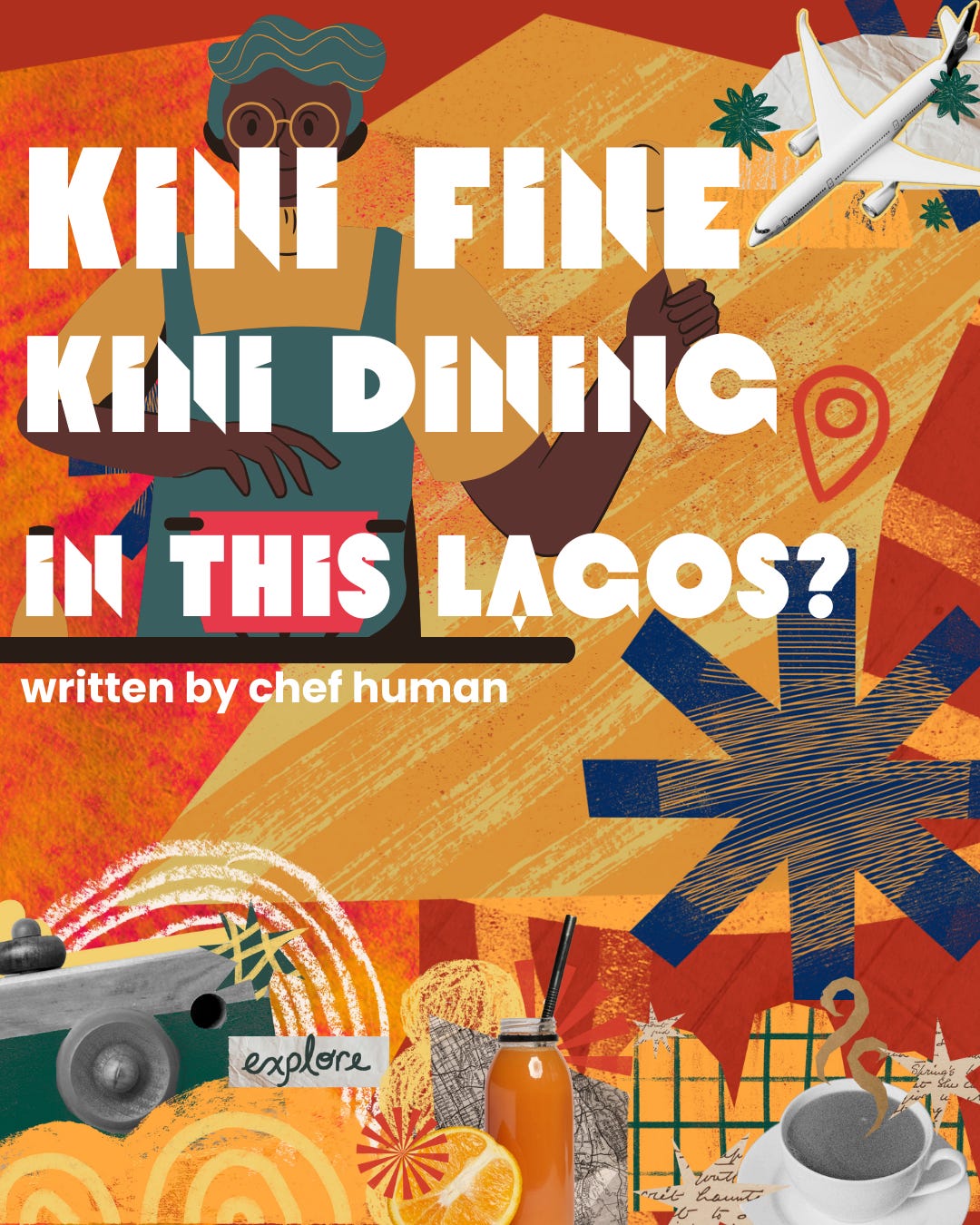
Does Fine Dining Exist in Lagos
A Question of Definition, Heritage, Art, and Responsibility.

This piece is written from an educational and cultural perspective, not as a ranking, endorsement, or dismissal of individual establishments.
The Noise Before the Meaning
Every now and then, a statement cuts through public discourse not because it is new, but because it is carelessly absolute. Recently, the assertion that “fine dining does not exist in Lagos” ignited a familiar cycle of outrage, defensiveness, misinterpretation, and emotional responses on all sides.
But beneath the uproar lies a more important question:
What do we truly mean when we say “fine dining”?
And even more critically: who gets to define it, contextualize it, and educate the public about it?
This piece/article is not a rebuttal driven by ego, nor a defense rooted in sentiment. It is an attempt to slow the conversation down, to unpack on all sides history, culture, art, and responsibility, so we can speak with clarity rather than noise.
Part One: What Fine Dining Truly Means
Origins and Philosophy
Fine dining did not emerge as a pricing model, aesthetic trend or dress code. Its roots trace back to 18th-century France, particularly after the French Revolution, when displaced aristocratic chefs began offering elaborate, structured meals to the public. I particularly like to tell people that chefs were regarded as kings, as they were only afforded by the elites of the elites in the olden era.
At the time, chefs were regarded with near-royal reverence, having previously cooked exclusively for the elite. Cuisine was not merely sustenance; it was power, symbolism, and craft embedded in service.
At its core, fine dining represents:
Intentionality – every element is designed, and nothing is accidental
Technical excellence – mastery of craft and processes
Structure – courses, pacing, balance, restraint
Service choreography – hospitality as a performance
Experience over sustenance – food as (a) narrative, not just nourishment
Fine dining is not defined solely by what is served, but by how, why, and for whom it is served.
The Definition of Fine Dining
Fine dining is a highly intentional culinary format where food, service, space, and narrative are designed to function as a single, coherent experience, rather than as a means of sustenance alone.
At its core, fine dining is defined by the following pillars:
1. Culinary Intent and Philosophy
Fine dining is guided by a clear culinary point of view.
Every dish exists for a reason, whether to express technique, seasonality, heritage, or a chef’s personal story. The menus are curated and not crowded.
2. Technical Excellence
It demands mastery of craft: precise cooking, balance of flavor, disciplined restraint, and consistency. Techniques are executed deliberately, often refined through repetition and critique.
3. Structured Experience
Meals follow a thoughtful progression; courses are paced to build rhythm, contrast, and emotional flow. The guests are guided, not rushed or overwhelmed.
4. Service as Performance
Service is choreographed, informed, and anticipatory. Staff are trained to explain, guide, and elevate the experience without intrusion. Hospitality is intentional, not casual.
5. Design and Atmosphere
The physical space supports the experience. Lighting, acoustics, tableware, and layout are chosen to frame the food and the moment, not distract from it.
6. Scarcity and Focus
Fine dining often limits choice and volume to protect quality. Smaller menus, fewer seats, and controlled service allow deeper attention to detail.
7. Cultural and Artistic Expression
Fine dining functions as a culinary art. It documents culture, time, place, and ideology, much like painting, music, or architecture, inviting your own interpretation rather than convenience.
What Fine Dining Is Not
It is not defined by price alone
It is not synonymous with luxury décor in isolation
It is not automatically or inherently Western
It is not mass-market or convenience-driven
The Purpose of Fine Dining
Fine dining exists to:
Preserve and reinterpret culinary techniques
Create immersive sensory experiences
Push boundaries of craft and creativity
Serve as cultural documentation of a people at a moment in time
It is culinary art governed by discipline, not extravagance for its own sake.
Globalization and Evolution
As fine dining traveled across borders, it evolved;
Japan infused it with minimalism and reverence
The Nordic countries stripped it down to terroir and seasonality
Latin America layered it with memory and political history
Fine dining was never meant to be static. It adapts, lest it disappear or die.
Part Two: African Food Heritage: Our Context Before Comparison
African, read Nigerian Cuisine Is Not “Behind.”
African food heritage predates most Western culinary systems. It is:
Communal rather than individualistic
Oral rather than documented
Rooted in abundance, adaptation, and survival
The issue has never been a lack of sophistication, but a lack of institutional framing.
Nigerian Food as a Case Study
Nigerian cuisine is deeply layered:
Complex soups and stews requiring a long duration of reduction with complex taste profiles
Fermentation techniques (iru, ogiri, ugba, and ogi)
Fire control, smoke infusion, and deliberate textural contrasts
Yet historically, Nigerian food has been presented primarily as home food or street food, not because it lacked refinement, but because refinement was not its social objective.
The challenge today is not whether Nigerian food can exist within fine dining spaces; it is whether we have done the curatorial, technical, and narrative work required to present it within that framework. Several emerging initiatives are attempting this work. See excerpts of my Introductory piece here -The African Journal For Culinary Arts.
Part Three: Fine Dining vs Upscale Dining, A Necessary Distinction
Upscale Restaurants
Upscale dining focuses on:
Premium ingredients
Attractive plating
Comfortable ambience
Elevated pricing
Luxurious décor
However, they often prioritize consistency and market appeal over experimentation, philosophy, or narrative depth.
Fine Dining Restaurants
Fine dining demands:
A clearly articulated culinary philosophy
Seasonally evolving menus
High staff-to-guest ratio
Rigorous technique
A coherent story from plate to palate
All fine dining is upscale, but not all upscale dining is fine dining.
Part Four: Does Fine Dining Exist in Lagos?
From an educational and institutional standpoint…
Yes, and not everywhere, not always, not perfectly, and not without room for growth.
Fine dining in Lagos exists in pockets, often:
As chef-led tasting experiences
As limited-seat pop-ups
As concept-driven menus rather than commercial ones
It may not always mirror Paris or Copenhagen, and it should not have to.
Within Lagos, Fine dining exists on a spectrum; no city emerges fully formed. There are restaurants and chef concepts in Lagos that meet many fine dining criteria:
Thoughtful tasting menus
Intentional service structures
Strong culinary narratives
Technical execution that, while evolving, demonstrates ambition
The gap today is not ambition or the lack thereof, but consistency, systems, and adequate and thorough training.
They may be young, evolving, and imperfect, but so was every fine dining scene at inception.
Outside Lagos, Fine dining experiences also exist in:
Private dining formats
Pop-ups and chef residencies
Destination restaurants in other Nigerian cities
To dismiss all of this as non-existent is not critique, it is complete erasure.
Part Five: Responsibility, Voice, and the Noise of Silence
When influential voices make sweeping claims without explanation or educational framing, the issue shifts. To adopt a popular saying from one of my favorite comics, Spiderman. -With great power comes great responsibility.
I strongly believe that reputation comes with responsibility, and Influence demands clarity.
If fine dining does not exist in Lagos, the public deserves to know:
By what standards
Through what framework
Compared to which global benchmarks
Silence, in this case, is not mystique; I dare say it is a missed opportunity for mentorship.
Conversely, while food enthusiasts may challenge the claim passionately, delivery matters. Without structure, context, and clarity, even valid arguments risk dismissal
Education requires translation, not just opposition.
Part Six: Art, Elitism, and Interpretation
What Is Art, and Why Does It Exist?
Art exists to:
Document human experience
Challenge perception
Evoke emotion
Preserve culture
It is not required to make immediate sense.
People pay exorbitantly for art not because they understand it fully, but because:
It represents mastery
It signals cultural capital
It holds narrative and history
Food as Art
If Picasso’s abstraction is elite, and the famous Mona Lisa’s subtlety is revered,
Should African reinterpretation be dismissed because it:
Adds spice
Alters form
Serves a different audience
Art is contextual, so is food.
To insist that fine dining must look Western to be legitimate is not preservation; it is a colonial hangover, and I dare say it’s residual.
The Question We All Should Be Asking
The real question is not “Does fine dining exist in Lagos?”
It is:
Are we defining fine dining narrowly or intelligently?
Are we building institutions or merely aesthetics?
Are our leading voices educating younger chefs, the public, and even the gazing eyes of the world, or simply guarding gates?
Fine dining in Lagos may still be evolving, but evolution is not absence.
And perhaps the most dangerous claim of all (particularly to the industry) is not that fine dining doesn’t exist in Lagos but that it isn’t worth explaining.
Well done!!👏✨